The boy would go to his sister’s appointments, and spend lots of time waiting to hear all the updates. The little girl had Pierre Robin Sequence, a rare condition with a cleft palate and undersized jaw. It ultimately required a dozen surgeries during her first two years of life.
Nicholas Blount was just 10 when his sister was born with the condition. But something set him apart from other concerned siblings who might be in his position. Eagerly listening to everything that was said, the surgeons would explain the procedures on pencil and paper to him in ways that he could understand.
Blount, now 26, was set on a course for helping care for patients like his sister. He is now on the cusp of earning his medical degree from the Hackensack Meridian School of Medicine in the spring.
“I saw the impact that surgeons have on patients and their families. I grew up saying I wanted to be a surgeon just like those who had helped my sister,” he said.
Recently an encounter in his quest of becoming a doctor brought him full-circle, back to those early procedures. But more on that later. Now he is poised at the cusp of being a doctor, with the aim of being a transplant surgeon for the road ahead.
“Nick Blount is a remarkable person who will soon be a remarkable doctor, who is bringing passion and experience into his calling,” said Jeffrey Boscamp, M.D. president and dean of the Hackensack Meridian School of Medicine.
EARLY START
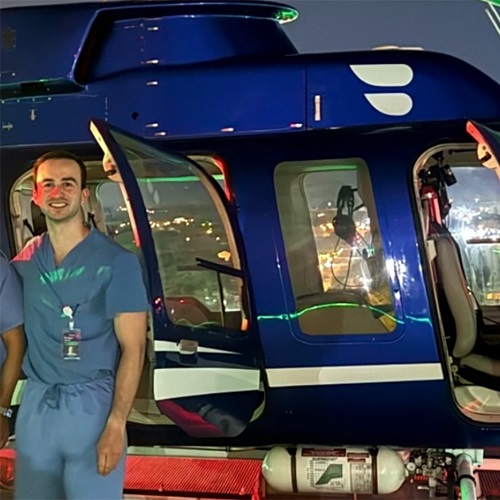
Blount parlayed his nascent passion for healing as soon as he could. He joined the Glen Rock Volunteer Ambulance Squad at age 17, and brought that expertise as an EMT to the campus of The College of New Jersey. By his senior undergraduate year, he was the chief of the squad.
Challenges - and opportunities - abounded. Right in the middle of his pursuit of a Biology degree, COVID-19 struck, effectively shutting down the Ewing, N.J. campus. But there were still emergencies, and still needs to be met. Together, Blount and colleagues found a way to reopen the squad following a brief shut down, and provide services locally. This became vital - because soon the pandemic required a massive public health effort.
“We started doing on-site COVID testing - I administered hundreds of tests a day,” recalled Blount.
The pressures of COVID-19 exacerbated mental-health issues for many - and Blount and others witnessed the fallout, first-hand. He seized the opportunity to get educated, get trained, and volunteer with the National Suicide Prevention Lifeline.
“During my years of EMS, the thing I knew the least about was psychiatric emergencies,” said Blount. “I decided it would be important to learn something about it. Even for surgeons, it’s always important to have the skills to meet the patients where they are.”
THE FIRST PATIENT
Growing up 15 minutes away and having some familiarity with the Hackensack Meridian Health network, Blount found HMSOM a good fit for his pursuit of a medical degree. His interest in transplant surgery developed following a transplant immunology lecture during his first year. Shortly after, he co-founded the Transplant Surgery Club, which gives first year students a pager so they can shadow transplants as they are happening in the network. He also served as a peer mentor and tutor to many throughout his time in medical school.
Blount was also avidly involved out in the community. The major Community Health Project he undertook through the Human Dimension program was a program designed to catch up on student health screenings in the Paterson Public Schools. After COVID-19 threw the schedule behind by roughly two years, Blount and others performed 800 screenings that revealed vision problems, scoliosis, and other necessary proactive findings.
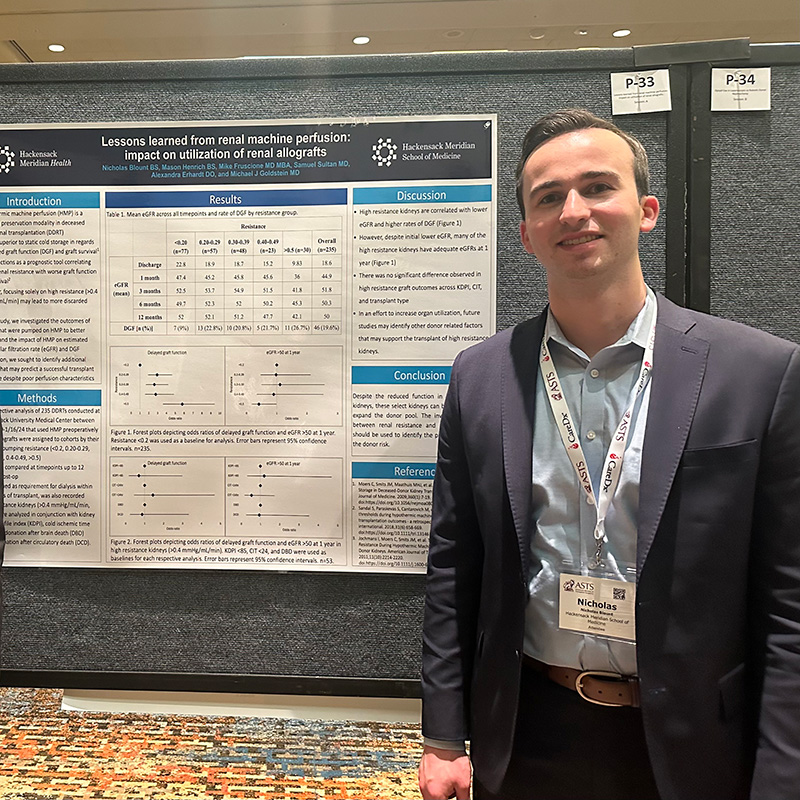
Research became a major thrust for him, as well. Presentations in the field of transplant surgery have taken him in recent years to conferences in Phoenix, San Francisco, and even Japan. Perhaps the most exciting finding he produced with colleagues was data showing that donor kidneys with sub-optimal perfusion numbers on preservation machines could still be suitable for transplant if they came from younger donors or had favorable biopsy results. That could mean that many more organs are viable than are traditionally believed - and more-life saving transplants might be performed than ever before.
Harder lessons were learned, too - Blount and his student partner had a VP participant in the Human Dimension who had diabetes and no teeth. They worked hard to help him improve his diet and even connect with a dental clinic. But unfortunately, COVID-19 came back around. The patient got sick, and after a battle in hospice, passed away.
“It was my first patient I lost,” he recalled. “It was meaningful, to learn how far he had come, and how we had worked together. It puts things into perspective.”
For Match Day, Blount hopes to pair with an institution in the Northeast which could allow him to pursue a general surgery residency. Only after five to seven years of that will he be able to specialize in abdominal transplant. His ultimate professional goal is to work at an academic medical center, operating, teaching, and leading.
A CHANCE ENCOUNTER IN THE O.R.
With his free time, Blount is training for a Spartan Race, and has self-taught himself piano, from “Clair de Lune” to Chopin’s Nocturnes, note by note.
His ultimate personal goal is to find a good balance between professional and personal time, which is always the challenge with a medical career in its early stages.
Growing up in Glen Rock, the oldest of four children, Blount played varsity basketball in high school. His younger siblings are growing up healthy - and that sister has recovered well.
Recently that initial inspiration all those years ago, as a boy, came rushing back - and in person. Though his sister had her surgery at New York University, the name he saw listed next to his own during his clerkship looked very, very familiar.
“By chance I ended up scrubbing in with one of those very surgeons on my clerkship at Hackensack who had operated on her 12 years prior,” Blount recalled recently. “It reminded me of why I am on this path.”